Brandon’s Architectural Styles
Post-Colonial Period (1790-1820)
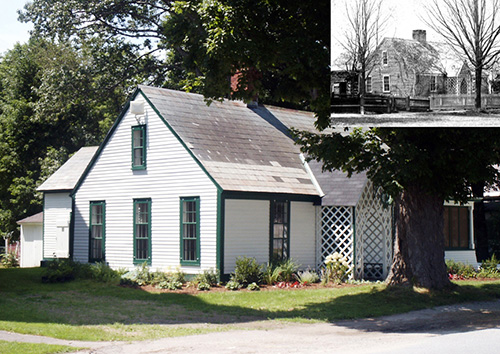
The Stephen A. Douglas Birthplace is a good example of the earliest houses that remain in Brandon. This period is characterized by a simple form, one-and-a-half or two stories, with little trim detail.
Federal period (to 1830’s)
This period in Brandon generally spans from the early years to the early 1830s and is characterized by simple facades, with the eave side often toward the street, and some entrances with rectangular, or semi-circular, transoms and long sidelights. Often chimneys are located at the end gables.
Greek Revival (1830 -1860)
Buildings built during this period generally have heavy cornices, elliptical-arched pediment vents, and fanlights, and many buildings are oriented with the gable end toward the street. Later, during the 1840s and 1850s, houses have dog-eared door and window fascia, flatter molding curves, and rectangular pediment vents replacing the earlier elliptical vents.
Gothic Revival (1850-1875)
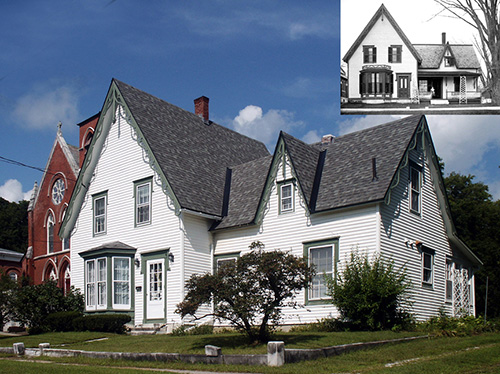
Brandon has several examples of this style of house, including this one at 42 Carver Street, with steep roofs and gables, oriels (bay-windows), and hood lintels on windows. The scrolled trim on the roof rakes gives it the carpenter character.
Italianate (1860-1875)
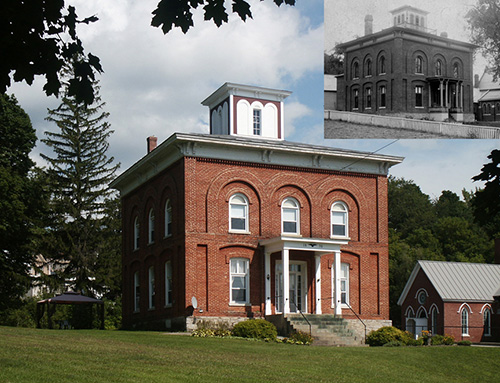
Generally having a tower, or, in this case at 38 Carver Street, cubic in form with a cupola on top, this style often is found with cornice brackets and single-storied entrance porches. As can be seen from the inset, this building once had a more-elaborate porch that was more characteristic of the period.
Second Empire (1870-1890)
Named for the style of building found in the Paris of Napoleon III, this style, exhibited here at 52 Park Street, generally is characterized by a mansard roof, and has many of the elements found in the Italianate Style: cornice brackets, heavy window and door trim, and entrance porches.
Shingle Style (1870-Early 20th Century)
Made popular by architects McKim, Mead, and White in Newport, RI, during the 1880s, the style spread through the country, being found in the work of California architects Greene & Greene among others. In Brandon it is exemplified in the gambrel-roofed Brandon Inn, built in 1892.
Victorian (1850 – Early 20th Century)
Buildings in the Victorian period tend to have more-significant stylistic elements such as towers, steeply pitched roofs, and what are called Gothic elements. This period includes buildings that are classified stylistically as Gothic Revival (Carpenter Gothic), Italianate, Second Empire, Queen Anne, and eclectic combinations of each. The Victorian period, in general, ended by the beginning of the 20th century, overlapping the Shingle, Craftsman, Bungalow and other styles of the early 20th century.
20th Century Bungalow (1900-1930)
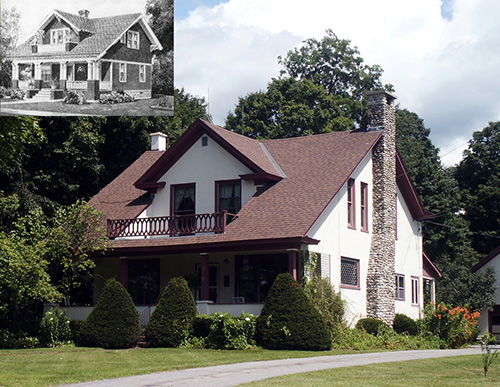
In the early part of the 20th century, homes—the materials or just the plans—could be purchased from catalogs published by Sears and Roebuck, Montgomery Ward, and others. The inset shows an image from a 1926 catalog. This house is at 149 North Street in Forest Dale.
Click each image below to enlarge!